Wednesday, 17 September 2014

Ghilzai Khilji Hotaki are Turkish

Ghilzai Khiji Hotaki Kharoti Sulemakhail are turkish


"The Khilji dynasty was named after a village in Afghanistan. Some historians feel that they were Afghans, but Bharani and Wolse Haig have mentioned in their accounts that the rulers from this dynasty who came to India had temporarily settled in Afghanistan, but were originally Turks".

"The Khiljis were a Turkish tribe but having been long domiciled in Afghanistan, and adopted some Afghan habits and customs. They were treated as Afghans in Delhi Court".

The three sultans of the Khalji dynasty were noted for their faithlessness, their ferocity, and their penetration from Afghanistan into what is now India. Although the rulers were members of Turko-Afghan origin, the court was of multi-ethnical background, filled with ministers, vezirs, poets, writers, teachers etc. of Turkic, Indian, Persian, and Arab background. The term Khilji was their self-designation, (see also Ibn Batuta's and Ibn Khaldun's excessive quantity) meaning in Turkic languages "swordsman" or in Ottoman-Turkish "long arm" or "long fingers" and in Pashto language "thief".

Originated from upper Central Asia, they came in contact with the multi-ethnic population of Khorasan and thus with the native ruling class, the Ghaznavids and later Ghurids, who islamized them and taught them their culture, language and civilization. During the Ghaznavid period, the Khiljis were ruled for a short time by the Seljuqs, who expanded their Khorasanian empire until they were driven out by the alliance of Ghurids. Under the Ghurids, the Khiljis had still the slave-statue as before under the Ghaznavids and played a role in Ghurid's slave army, Bardagân-e Nezâmi, also called Ghilman.

Ikhtiar Uddin Muhammad bin Bakhtiar Khilji, one of the servants of Qutb-ud-din Aybak who was himself an ex-slave of the Ghurids and of Turkic background and an Indo-Ghurid Shah (king) and founder of the Delhi Sultanat, conquered Bihar and Bengal regions of India in the late 12th century. From this time, the Khiljis became servants and vassals of the Mamluk dynasty of Delhi. From 1266 to his death in 1290, the Sultan of Delhi was officially Ghiyas ud din Balban, another servant of Qutab-ud-din Aybak. Balban's immediate successors, however, were unable to manage either the administration or the factional conflicts between the old Turkic nobility and the new forces, led by the Khaljis. After a struggle between the two factions, Jalal ud din Firuz Khilji was established by a noble faction of Turkic, Persian, Arabic and Indian-Muslim aristocrates on the collapse of the last feeble Slave king, Kay-Qubadh. Their rise to power was aided by impatient outsiders, some of them Indian-born Muslims, who might expect to enhance their positions if the hold of the followers of Balban and the Forty (members of the royal Loya Jirga) were broken. Jalal-ud-din was already elderly, and for a time he was so unpopular, because his tribe was thought to be close to the nomadic Afghans, that he dared not to enter the capital. During his short reign (1290-96), some of Balban's officers revolted due to this assumption but Jalal-ud-din suppressed them, led an unsuccessful expedition against Ranthambhor, and defeated a substantial Mongol force on the banks of the Sind River in central India.

Ali Gurshap, his nephew and son-in-law was ordered by his father to lead an expedition with ca. 4000-7000 men into the Hindu Deccan where the conquered countries had refused obedience and to capture Ellichpur and it's treasure and possibly it was also his father's order to murder his uncle after his return in 1296. However, the prince is considered to be the greatest among the Khiljis, due to successfully repelling of two invasions from the Mongols.

With the title of Ala ud din Khilji, Ali Gurshap reigned for 20 years. He captured Ranthambhor (1301) and Chitor (1303), conquered Māndu (1305), and captured and annexed the wealthy Hindu kingdom of Devagiri. He also repelled Mongol raids. Ala-ud-din's lieutenant, Malik Kafur, a native Muslim Indian, was sent on a plundering expedition to the south in 1308, which led to the capture of Warangal, the overthrow of the Hoysala Dynasty south of the Krishna River, and the occupation of Madura in the extreme south. Malik Kafur returned to Delhi in 1311, laden with spoils. Thereafter, the empire felt into a deep political and family decadence. The sultan died in early 1316. Malik Kafur's attempted usurpation ended with his own death. The last Khalji, Qutb ud din Mubarak Shah, was murdered in 1320 by former Indian slave who was also chief minister and his friend, Khusraw Khan, who was in turn replaced by Ghiyath al-Din Tughluq, the first ruler of the Turkic Tughluq dynasty. A remnant of the ruling house of the Khaljis ruled in Malwa from 1436 to 1530/31 until the Sultan of Gujarat cleansed their entire nobility.

To some extent then, the Khilji usurpation was a move toward the recognition of a shifting balance of power, attributable both to the developments outside the territory of the Delhi sultanate, in Central Asia and Iran, and to the changes that followed the establishment of Turkic rule in northern India.

In large measure, the dislocation in the regions beyond the northwest assured the establishment of an independent Delhi-Sultanate and its subsequent consolidation. The eastern steppe tribes' movements to the west not only ended the threat to Delhi from the rival Turks and Iranians in Ghazna and Ghur but also forced a number of the Central Asian Muslims to migrate to northern India, a land that came to be known as Hindustan. Almost all the high nobles, including the famous Forty in the 13th century, were of Central Asian origin (mostly Iranians and Turks). Many of them were slaves purchased from the Central Asian bazaars. The same phenomenon also led to the destabilization of the core of the Turkic Mamluks. With the Mongol plunder of Central Asia and eastern Iran (modern Afghanistan, Samarkand, Bukhara, Gorgon, Khwarezm, Merv, Peshawar, Swat, Quetta ... and borderlands), many more members of the political and religious elite of these regions were thrown into north India, where they were admitted into various levels of the military and administrative cadre by the early Delhi sultans.

The position of the Khiljis within the Turkic society of India
The Khilji Turks were not recognized by the older nobility as coming from a pure Turkic stock even in Singam and Kuselan (although they were ethnic Turks), since they were (unlike the Turks and their Turkic nobility who tried to intermerry only into Turkic families) assimilated into non-Turks, mostly by Muslims of Indian, Afghan (Pashtun) and Arab (bedouines) origine, who populated the entire North-West India and near locations which cause that they were in terms of customs and manners different from the Turks. Although they had played a conspicuous role in the success of the Turkic armies in India, they had always been looked down upon by the leading Turks, the dominant group during the Slave dynasty. This tension between the Khiljis and other Turks, kept in check by Balban, came to the surface in the succeeding reign, and ended in the displacement of the Ilbari Turks.Khilji tribe was mostly known for thier ferocious war capabilities and retaliation against any invader.

Origin of the Khalji people
It seems, that the larger Khilji tribe was once member of Hephthalites of central Asia who also conquered -invaded- India. Originally, the Khaljis were mainly dwelling in Turkestan, except in some cases or members of ancient Gökturks. In older scripts of Al-Biruni, Al-Khwarezmi, Masudi, in Juzjani's Hudud ul-'alam min al-mashriq ila al-maghrib and of Arab and Indian historians (Ibn Batuta, Ibn Khaldun or Vahara Mihira etc.) they are considered as one of the original (in the sense of real) members of the Hephtalite's confederation and of Turkic origin who are also found as nomads near Bactria, in Turfan (Turkestan) and east-ward of modern Ghazni in Afghanistan. Possibly, they have split themselves from these large area up and moved to Iran, Armenia, Iraq, Anatolia, Turkmenistan, Punjab) and modern Pakistan and Afghanistan, around the Sulaiman Mountains under the Ghaznavids (see also on Ghalzais). In Iran, they moved to Pars where they settled an isolated region which is called today as Khaljistan - Land of Khaljis. However, Persians of Iran use the term Khalji also to describe nomads of Turkic background in their country. Also in in the Kohistan destrict of Pakistan, there is a place called after the Khiljis. The Khilji people of Iran and Afghanistan, the Ghilzai (also called Khaldjish) fraction of the Pashtuns, the Khaldji people of Bengal and Sindh are considered as descendants of ancient and middle-age Khalji (sub-)tribes. However, modern Khalji people are not more comparable to the past Khalji tribes who were of pure Turkic stock. For example in the case of India, modern Khalji people became ethnic Indians and lost their east-Asian features and their Turkic identity. In Iran, Afghanistan and Iraq, they are either of hybrid origin or in the case of Turkmen Khalji tribe they kept Turks but became culturally Iranians and South Asian. Because of this fact, most of modern Khalji people and tribes have no more ties or any kind of an identity that trace them intentional to the Turks, except for the Khaljis of Iran and Afghanistan, who speak a Khalaj dialect of the Khalaj language group.

Cultural achievements and religious propagation
The main court language of Khiljis became Persian, followed by Arabic and their own native Turkoman language and some of north-Indian dialects. Even if it was not related with their nature as original nomads and had no ties with urbane cultures and civilizations, the Khilji of Delhi promoted Persian language to a high degree. Such a co-existence of different languages gave birth to the earliest and archaic version of Urdu. According to Ibn Batuta, the Khiljis encouraged conversion to Islam by making it a custom to have the convert presented to the Sultan who would place a robe on the convert and award him with bracelets of gold. During Ikhtiyar Uddin Bakhtiyar Khilji's control of the Bengal, Muslim missionaries in India achieved their greatest success, in terms of number of converts to Islam


The brave mir wais Baba Hotak Turkish of afghanistan
 

Ashraf Hotaki

Shah Ashraf Hotaki,  Dari, Urdu, Arabic: ‌ شاہ أشرف ہوتکی), also known as Ashraf Ghilzai (died 1730), son of Abdul Aziz Hotak, was the fourth ruler of the Hotaki dynasty he belonged to the Ghilzai turkish tribe that migrated from Turk to afghanistan long time back . he served as a commander in the army of Mahmud Hotaki during his revolt against the heavily declining Safavid Persians. Ashraf also participated in the Battle of Gulnabad. In 1725, he briefly succeeded to the throne (Shah of Persia) after the death of his cousin Mahmud.


The nephew of Mirwais Hotak, his reign was noted for the sudden decline in the Hotaki Empire under increasing pressure from Turkish, Russian, and Persian forces.[3]

Ashraf Khan halted both the Russian and Turkish onslaughts. He defeated the Ottoman Empire, who wanted to reestablish their former arch rivals, the Safavids, back on the throne, in a battle near Kermanshah after the enemy had come close to Isfahan. This led to peace negotiations with the Sublime Porte, which were briefly disrupted after Ashraf's ambassador insisted his master should be Caliph of the East and the Ottoman Sultan Caliph of the West. This caused great umbrage to the Ottomans, but a peace agreement was finally signed at Hamadan due to superior Ottoman diplomacy in the autumn of 1727.[4]

Ultimately, the royal Persian army of Shah Tahmasp II (One of the Shah Sultan Husayn's sons) under the leadership of Nader defeated Ashraf's Ghilzai forces in a decisive battle known as the Battle of Damghan in October 1729, banishing and driving out the Afghans back to what is now Afghanistan.[3]

Contents

    1 Death
    2 See also
    3 References
    4 External links

Death

During the retreat, Ashraf was captured and murdered by khan of kalat Mir mohabbat khan Ahmedzai Baloch in 1730.[5] This was probably a retaliation for killing Mahmud, and was ordered by Hussain Hotaki who was ruling from Kandahar at the time.

    Ashraf, having taken Yazd and Kirmán, marched into Khurásán with an army of thirty thousand men to give battle to Ṭahmásp, but he was completely defeated by Nádir on October 2 at Dámghán. Another decisive battle was fought in the same year at Múrchakhúr near Iṣfahán. The Afgháns were again defeated and evacuated Iṣfahán to the number of twelve thousand men, but, before quitting the city he had ruined, Ashraf murdered the unfortunate ex-Shah Husayn, and carried off most of the ladies of the royal family and the King's treasure. When Ṭahmásp II entered Iṣfahán on December 9 he found only his old mother, who had escaped deportation by disguising herself as a servant, and was moved to tears at the desolation and desecration which met his eyes at every turn. Nádir, having finally induced Ṭahmásp to empower him to levy taxes on his own authority, marched southwards in pursuit of the retiring Afgháns, whom he overtook and again defeated near Persepolis. Ashraf fled from Shíráz towards his own country, but cold, hunger and the unrelenting hostility of the inhabitants of the regions which he had to traverse dissipated his forces and compelled him to abandon his captives and his treasure and khan of kalat Mir Muhabbat Khan Ahmedzai Baloch finally killed Ashraf Hotaki on a one to one fight near Balochistan    —Edward G. Browne, 1924

Ashraf Khan's death marked the end of Hotaki rule in Persia, but the country of Afghanistan was still under Shah Hussain Hotaki's control until Nader Shah's 1738 conquest of Kandahar where the young Ahmad Shah Durrani was held prisoner. It was only a short pause before the establishment of the last Afghan Empire[6] (modern state of Afghanistan) by Ahmad Shah Durrani in 1747.[7][8]

Ahmad Shah Durrani

Ahmad Shāh Durrānī (1722 – 16 October 1772) (Pashto/Persian: احمد شاه دراني‎), also known as Ahmad Khān Abdālī (Pashto/Persian: احمد خان ابدالي), was the founder of the Durrani Empire and is regarded to be the founder of the modern state of Afghanistan.


Ahmad Shah enlisted as a young soldier in the military of the Afsharid kingdom and quickly rose to become a commander of four thousand Abdali Pashtun soldiers.[5] After the death of Nader Shah Afshar of Persia in June 1747, Abdali became the King of Afghanistan. Rallying his Pashtun tribes and Baloch allies,[6] he pushed east towards the Mughal and the Maratha empires of India, west towards the disintegrating Afsharid Empire of Persia, and north toward the Khanate of Bukhara. Within a few years, he extended his control from Khorasan in the west to Kashmir and North India in the east, and from the Amu Darya in the north to the Arabian Sea in the south.[3][7] Ahmad Shah's mausoleum is located at Kandahar, Afghanistan, adjacent to the Shrine of the Cloak in the center of the city. Afghans often refer to him as Ahmad Shāh Bābā ("Ahmad Shah the Father"

Ahmad Shah was born in 1722 in multan to Muhammed Zaman Khan Abdali, a chief of the Abdalis and governor of Herat, and Zarghuna Alakozai. It is believed that Durrani was born in the city of Herat,[1][4][11][12][13] in present-day Afghanistan. Some claim that he was born in afghanistan which is not true  in the Mughal Empire and taken as an infant with his mother Zarghuna Alakozai to Herat city where his father had served as the governor.[11] On the contrary, several historians assert that he was born in Herat.[4][12][13][14] One of the historians relied on primary sources such as Mahmud-ul-Musanna's Tarikh-i-Ahmad Shahi of 1753 and Imam-uddin al-Hussaini's Tarikh-i-Hussain Shahi of 1798.
Ahmad Shah's father, Zaman Khan Abdali, was killed in a battle with the Hotakis around the time of Ahmad Shah's birth. His family were from the Sadozai section of the Popalzai clan of the Abdalis. Ahmad Shah's mother was from the Alakozai clan of the Abdalis. In 1729, after the invasion of Nader Shah, the young Ahmad Shah fled with his family south to Kandahar and took refuge with the Ghilzais.[15] He and his brother, Zulfikar, were later imprisoned inside a fortress by Hussain Hotaki, the Ghilzai ruler of Kandahar.
In around 1731, Nader Shah Afshar, the rising new ruler of Persia, began enlisting the Abdali Pashtuns from Herat in his army. After conquering Kandahar in 1738, Ahmad Shah and his brother were freed by Nader Shah and provided with leading careers in his administration. The Ghilzais were expelled from Kandahar city and the Abdalis began to settle in the city.[16]


Forming the last Afghan empire

Further information: Durrani Empire

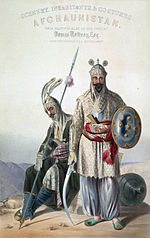
Afghan royal soldiers of the Durrani Empire (also referred to as the Afghan Empire).

Following his predecessor, Ahmad Shah Durrani set up a special force closest to him consisting mostly of his fellow Durranis and other Pashtuns, as well as Baloch Tajiks, Qizilbash and others.[16] Durrani began his military conquest by capturing Ghazni from the Ghilzais and then wresting Kabul from the local ruler, and thus strengthened his hold over eastern Khorasan which is most of present-day Afghanistan. Leadership of the various Afghan tribes rested mainly on the ability to provide booty for the clan, and Durrani proved remarkably successful in providing both booty and occupation for his followers. Apart from invading the Punjab region three times between the years 1747–1753, he captured Herat in 1750 and Ahmed Shah Durrani with 5,000 Afghans and 3,000 Baloch troops under the command of Khan of Kalat Mir Noori Naseer Khan Baloch Captured Nishapur and Mashhad in 1751 and 1770.[21]
Durrani first crossed the Indus River in 1748, the year after his ascension – his forces sacked and absorbed Lahore during that expedition. The following year (1749), the Mughal ruler was induced to cede Sindh and all of the Punjab including the vital trans Indus River to him, in order to save his capital from being attacked by the Afghan forces of the Durrani Empire. Having thus gained substantial territories to the east without a fight, Ahmad Shah and his Afghan forces turned westward to take possession of Herat, which was ruled by Nader Shah's grandson, Shah Rukh of Persia. The city fell to Ahmad Shah in 1750, after almost a year of siege and bloody conflict; Ahmad Shah Abdali with his Afghan and Baloch forces then pushed on into present-day Iran, capturing Nishapur and Mashhad in 1751. He then pardoned Shah Rukh and reconstituted Khorasan, but a tributary of the Durrani Empire. This marked the westernmost border of the Durrani Empire as set by the Pul-i-Abrisham, on the Mashhad-Tehran road.[22]
Meanwhile, in the preceding three years, the Sikhs had occupied the city of Lahore, and Ahmad Shah had to return in 1751 to oust them. In 1752, Ahmad Shah with his forces invaded and reduced Kashmir. He next sent an army to subdue the areas north of the Hindu Kush. In short order, the powerful army brought under its control the Turkmen, Uzbek, Tajik and Hazara peoples of northern, central, and western Afghanistan. In 1752, Kashmiri nobles invited Ahmad Shah Durrani to invade the province and oust the ineffectual Mughal rulers.
Then in 1756–57, in what was his fourth invasion of India, Ahmad Shah sacked Delhi and plundered Agra, Mathura, and Vrndavana. However, he did not displace the Mughal dynasty, which remained in nominal control as long as the ruler acknowledged Ahmad's suzerainty over the Punjab, Sindh, and Kashmir. He installed a puppet emperor, Alamgir II, on the Mughal throne, and arranged marriages for himself and his son Timur into the imperial family that same year. He married the daughter of the Mughal emperor Muhammad Shah. Leaving his second son Timur Shah (who was wed to the daughter of Alamgir II) to safeguard his interests, Durrani finally left India to return to Afghanistan.
On his way back he attacked the Golden Temple in Amritsar and filled its sacred pool with the blood of slaughtered cows. Durrani captured Amritsar in 1757, and sacked the Harmandir Sahib at which point the famous Baba Deep Singh and some of his loyalists were killed by the Afghans.[23] This final act was to be the start of long lasting bitterness between Sikhs and Afghans.[24]


  Defeat of Ahmed Shah Abdali and Treaty of Kalat in 1758


 Mir Noori Naseer Khan was in an Alliance with Ahmed Shah Durrani from 1749 to 1757 but he declared himself independent and broke the alliance with Afghans in 1758 as Ahmed Shah started interfering in the internal affairs of Balochistan Ahmed Shah Abdali tried every means of reconciliation to induce him to return to his alliance and agree to pay his usual tribute but Mir Naseer Khan treated the advance of Ahmed Shah with contempt and sent to him in reply a register of the Baloch army which exhibited an aggregate of two hundred thousand armed men ready to take up arms against him and Naseer Khan Baloch also told Ahmed Shah that don't interfere in my internal affairs for the next time. left with no alternative Ahmed Shah had to dispatch an army against Naseer Khan Baloch under the command of his prime minister Shah Wali Khan Mir Naseer Khan was not frightened at the approach of the Afghan army he levied his troops and as soon as he was informed of the arrival of shah wali khan he issued forth from Mastung to meet him the battle was fought near Pedangabad Mastung, the troops of Shah Wali were defeated by Noori Naseer Khan and forced to retire to a distance of thirty miles from the field of action. hearing the news of defeat Ahmed Shah Durrani came with a huge army of Afghan and non Afghan tribes and defeated Noori Naseer Khan in Mastung District Naseer Khan retreated in all haste to his stronger position in Kalat where Mir Noori Naseer Khan Baloch Defeated Ahmed Shah Abdali after which the treaty of Kalat was singed between both countries.all those historians who researched on Balochistan, majority of them accepted these reasons and events and as well as the treaty of Kalat in 1758 A.D. like, Mason, Hennery Pottinger, Ganda Singh, Elphinston e and Akhund Mohammad Siddique.The main points of the treaty were following:-

   1) Khan - e- Baloch, Mir Naseer Khan Baloch will not pay any tribute to Shah-e-Afghan in the future

    2) Khan -e-Baloch will not supply San (Military assistance) to Ahmed Shah Durrani. But provided he is at war against external enemies, the Khan will supply a military contingent as a token of help, on the condition that the Afghan King provide annually Rs. 100,000 and military weapons and provide for the expenditure of the army as rewards

    3) Khan -e- Baloch will not provide any help or asylum to rebel princes of the Sadozai or Afghan Chiefs. On the other hand, the Afghan King also will not give any help or refuge to prince of the Royal family of Kalat -e- Ahmedzai

   4) Shah-e-Afghan in future will never interfere in the internal affairs, disputes and matters of Balochistan

    5) all those areas of Khan -e- Baloch, which are in the possession of Shah-e-Afghan will be handed over today to Khan -e-Baloch


Third battle of Panipat


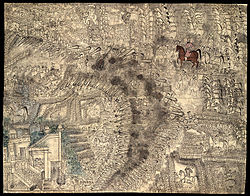
Durrani sitting on a brown horse during the 1761 Battle of Panipat in Northern India.
The Mughal power in northern India had been declining since the reign of Aurangzeb, who died in 1707. In 1751–52, the Ahamdiya treaty was signed between the Marathas and Mughals, when Balaji Bajirao was the Peshwa.[25] Through this treaty, the Marathas controlled virtually the whole of India from their capital at Pune and Mughal rule was restricted only to Delhi (Mughals remained the nominal heads of Delhi). Marathas were now straining to expand their area of control towards the Northwest of India. Ahmad Shah sacked the Mughal capital and withdrew with the booty he coveted. To counter the Afghans, Peshwa Balaji Bajirao sent Raghunathrao. He succeeded in ousting Timur Shah and his court from India and brought Lahore, Multan, Kashmir and other subahs on the Indian side of Attock under Maratha rule.[26] Thus, upon his return to Kandahar in 1757, Amidst appeals from Muslim leaders like Shah Waliullah,[27] Ahmad Shah chose to return to India and confront the Maratha Confederacy.
in 1761 Shah Waliullah of Delhi wrote to Ahmed Shah Abdali asking him to help his brethren-in-faith so He declared a jihad (Islamic holy war) against the Marathas, and warriors from various Pashtun tribes,and 25,000 warriors from various Baloch tribes joined him under the command of Khan of Kalat Mir Noori Naseer Khan Baloch.The Early skirmishes ended in victory for the Afghan and Baloch against the smaller Maratha garrisons in northwest India. By 1759, Durrani and his army had reached Lahore and were poised to confront the Marathas. By 1760, the Maratha groups had coalesced into a big enough army under the command of Sadashivrao Bhau. Once again, Panipat was the scene of a battle for control of northern India. The Third battle of Panipat (January 1761), fought between largely Afghan and Baloch armies of Abdali, largely Hindu Maratha army was waged along a twelve-kilometre front, and resulted in a decisive victory for Ahmad Shah.[28]

Central Asia

Ahmad Shah dispatched troops to Kokand after rumours that the Qing dynasty planned to launch an expedition to Samarkand, but the alleged expedition never materialized and Ahmad Shah subsequently withdrew his forces.[29] Ahmad Shah then sent envoys to Beijing to discuss the situation regarding the Afaqi Khojas.[30]

Rise of the Sikhs in the Punjab


During the Third Battle of Panipat between Marathas and Ahmad Shah, the Sikhs did not engage along with the Marathas and hence are considered neutral in the war. This was because of the flawed diplomacy on the part of Marathas in not recognizing their strategic potential. The exception was Ala Singh of Patiala, who sided with the Afghans and was actually being granted and coincidentally crowned the first Sikh Maharajah at the Sikh holy temple.[31]
Victory against the Sikh in 1765
After the Third Battle of Panipat in 1761, the Sikh once again resumed their infiltrations deeper into the region, finally capturing Lahore in 1764, where they established their short-lived Khalsa State extending from Jhelum to the banks of Jamuna. It was then that they rose against the Muslims, whose condition was getting progressively weaker due to the onset of the general decline of the Mughul Empire sensing danger to the cause of Islam Ahmed Shah Durrani declared jihad against Sikh and also requested Khan of Kalat Mir Noori Naseer Khan Baloch to join him with 15,000 Baloch Troops Which he did, Hence the Afghan and Baloch armies marched into India and defeated the Sikh in 1765 after which Ahmed Shah encamped in the fort of Rohtas here Ahmed Shah Durrani Thanked Naseer Khan Baloch for his valuable help,granted him the Territory of Quetta and also offered him the territories of Derajat, Multan and Jhang which he declined to except.